

Non-Destructive Testing
Proven Methods to Save Time and Money
Non-destructive testing plays a vital role in YA Group’s investigations and allows us to determine the extent and underlying cause of distress in all kinds of buildings and structural components. While traditional load testing or destructive testing approaches can be effective, they are often invasive, time-consuming, and expensive. In contrast, non-destructive evaluation (NDE) methods enable us to gather a clear picture of existing conditions and material characteristics while also identifying signs of distress without modifying or damaging the structure. Used independently or alongside conventional testing and analysis, these techniques provide meaningful insights.
Non-destructive testing methods include:
- Corrosion rate assessment
- Half-cell corrosion potential
- Mild reinforcement and post-tensioning detection
- Thickness of concrete studies
- Ground penetrating radar
- Impact echo testing
- Ultrasonic pulse velocity testing
- Shear wave ultrasonic tomography

Example Project
Digester Tank 3 is a reinforced concrete tank, constructed circa 1950, that measures approximately 100 feet in diameter and has a nominal 16-inch-thick wall. At the top of the wall, the section tapers inward, forming a 10-inch high by 12-inch-wide concrete curb. Shortly after a new roof membrane was installed, portions of the concrete curb ring failed, causing the membrane to collapse.
Findings and Conclusions
UPV testing produced an average P-wave velocity of approximately 11,700 ft/s around the curb perimeter, indicating concrete of marginal quality.
GPR testing identified two layers of vertical reinforcing bars, spaced roughly 12 inches apart. The data also showed that the vertical bars did not extend into the upper portion of the curb. GPR additionally confirmed the presence and spacing of anchor bolts, interior bolts at 12 inches, and exterior bolts at 8 inches.
Combined NDT results guided the selection of core sampling locations for laboratory compressive strength and petrographic examination.
Client Experience

Rebuilding after Hurricane Melissa
In October 2025, Hurricane Melissa—a Category 5 storm—made historic landfall in Jamaica, leaving cat...
See More
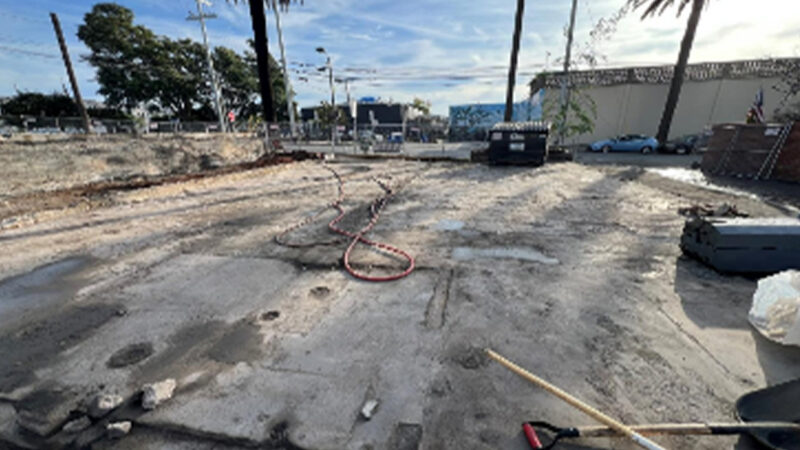
Fire Damage Assessment of Concrete Foundation of a Multi-Tenant Retail Property
Learn how YA Group used concrete foundation inspections, fire damage assessment, and UPV testing to ...
See More
Rebuilding after Hurricane Melissa
In October 2025, Hurricane Melissa—a Category 5 storm—made historic landfall in Jamaica, leaving cat...
See More
Fire Damage Assessment of Concrete Foundation of a Multi-Tenant Retail Property
Learn how YA Group used concrete foundation inspections, fire damage assessment, and UPV testing to ...
See More
Latest Insights
June 30, 2026
|
1 min read

Hurricane Preparedness and Risk Mitigation Strategies
Hurricane activity remains a significant source of property risk across many regions of the United States. In this article, YA Group explores practical strategies for hurricane preparedness, risk mitigation, and disaster recovery to help organizations strengthen resilience before, during, and after ...
Navigating Construction Defects: Lessons from a High-Stakes Case
In today’s construction landscape, disputes over defects can quickly escalate into multi-million-dollar claims, putting ...
10 Reasons to Enforce a High Standard of Schedule Quality
High-quality construction schedules can save millions by ensuring credible delay analysis and robust project planning. F...
Hurricane Preparedness and Risk Mitigation Strategies
June 30, 2026
|
1 min read
Hurricane activity remains a significant source of property risk across many regions of the United States. In this ar...
Navigating Construction Defects: Lessons from a High-Stakes Case
February 4, 2026
|
1 min read
In today’s construction landscape, disputes over defects can quickly escalate into multi-million-dollar claims, putti...
10 Reasons to Enforce a High Standard of Schedule Quality
February 4, 2026
|
1 min read
High-quality construction schedules can save millions by ensuring credible delay analysis and robust project planning...