Summary
In 2022, Florida faced the formidable challenge of Hurricanes Ian and Nicole, each leaving significant impacts across the state. As a requirement to maintain Florida’s enhanced funding status with FEMA, FDEM tasked YA Group (YA) with analyzing a variety of hazard mitigation projects including elevation, mitigation reconstruction, drainage, acquisitions, and wind retrofit projects to measure the mitigation projects’ performance against these hurricanes.
All Florida counties were affected by at least one of the hurricanes and were analyzed in the 2022 Loss Avoidance Assessment. YA improved on the existing methodology, updated existing resources, and created a thorough report that demonstrated that mitigation is effective and worth funding.
- Two major hurricanes analyzed
- All 67 Florida counties were analyzed across all storm events then narrowed down to counties most affected by the hurricanes
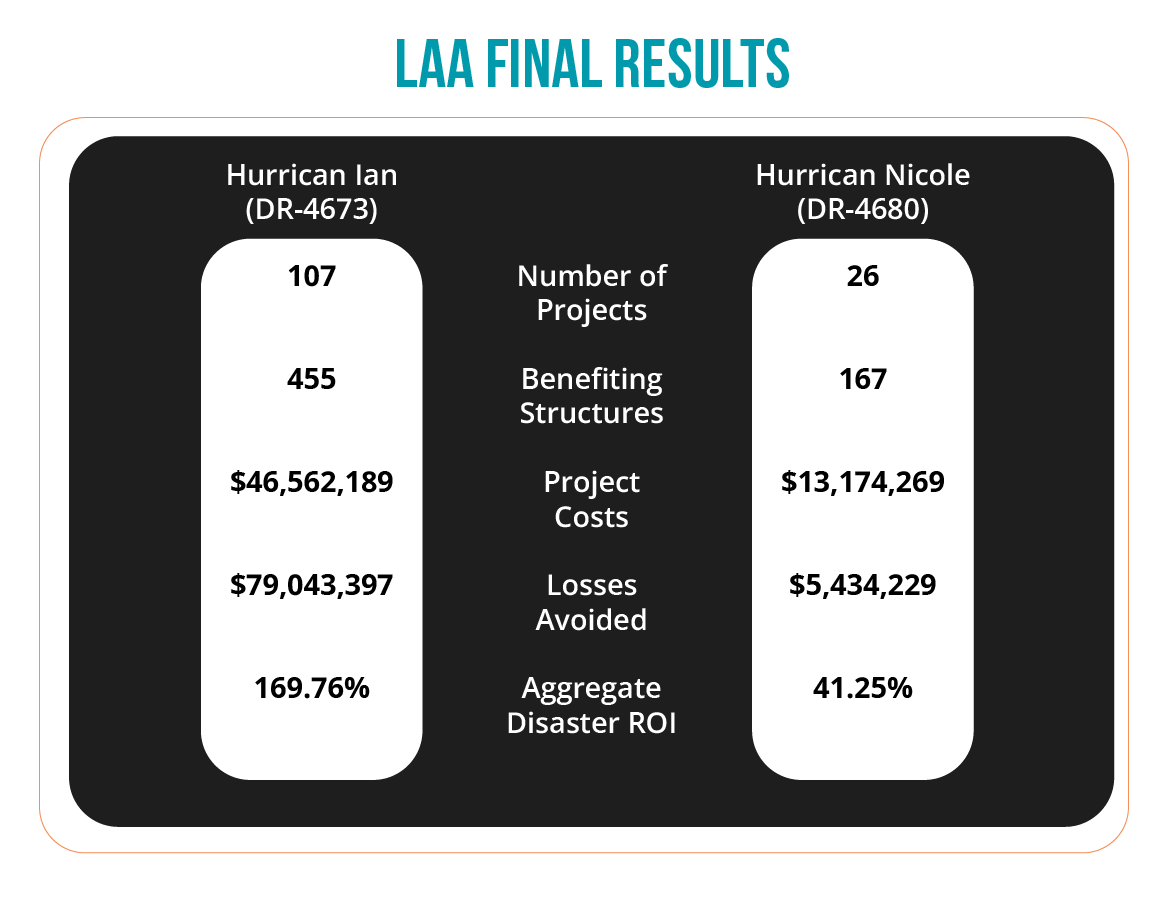
- 133 mitigation projects were analyzed which included 622 mitigated structures
- Acquisition
- Elevation
- Wind Retrofit
- Mitigation Reconstruction
- Drainage
- $84,477,626 in total losses avoided with an aggregate ROI of 169.76% for Ian and 41.25% for Nicole
Challenge Overview
As required by its FEMA-approved Enhanced State Hazard Mitigation Plan, Florida routinely undertakes Loss Avoidance Assessments (LAAs) post-major disaster declarations. These assessments are crucial, enabling the state to demonstrate the real-world impact of its mitigation measures in terms of reducing or preventing losses from such catastrophic events. They are also vital for strategic planning, providing Florida with the insights needed to refine its approach to mitigating damage and losses in an era of increasingly severe weather phenomena. A key element in these evaluations is the calculation of return on investment (ROI), providing a tangible measure of a project’s cost-effectiveness.
The aftermath of Hurricanes Ian and Nicole necessitated a comprehensive LAA by the FDEM Mitigation Bureau. Tasked by FDEM, our team at YA Group spearheaded the LAA for both hurricanes, following the State’s guidelines as outlined by FEMA’s Enhanced State Hazard Mitigation Plan. The project required extensive data analysis, scrutinizing a variety of hazard mitigation projects funded through various State and Federal grant programs since 2012, employing a robust data-driven approach to evaluate their effectiveness.